
Acid, Oil, and Deep Time
The Extraordinary Story of Carlsbad Caverns

Entrance to Carlsbad Caverns National Park, New Mexico
In the first instalment of this series, we walked the Permian Reef Trail at Guadalupe Mountains National Park, scrambling over the remnants of a 265-million-year-old reef. We moved upward through the fore-reef and slope deposits, past fossil-studded limestone, into open desert sky.
Carlsbad Caverns, about 60 km to the northeast across the New Mexico state line, is the same story told from underground, with a twist that makes it one of the most geologically unusual places on the planet.
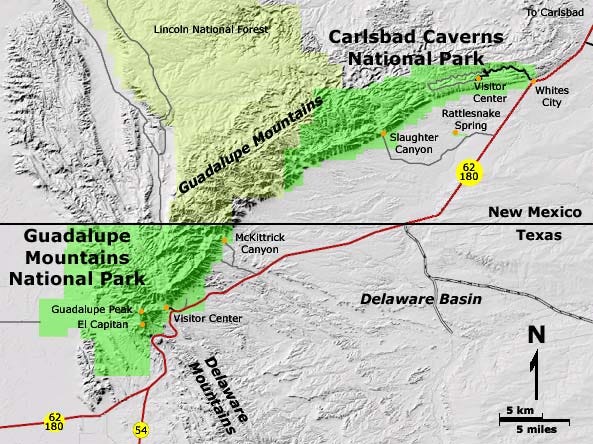
Regional map showing Guadalupe Mountains National Park and Carlsbad Caverns National Park. (Image from USGS)
The Same Reef, From Below
The limestone we explored on the Permian Reef Trail and the limestone enclosing Carlsbad Caverns are identical: the Capitan Formation, remains of the ancient Permian reef system.
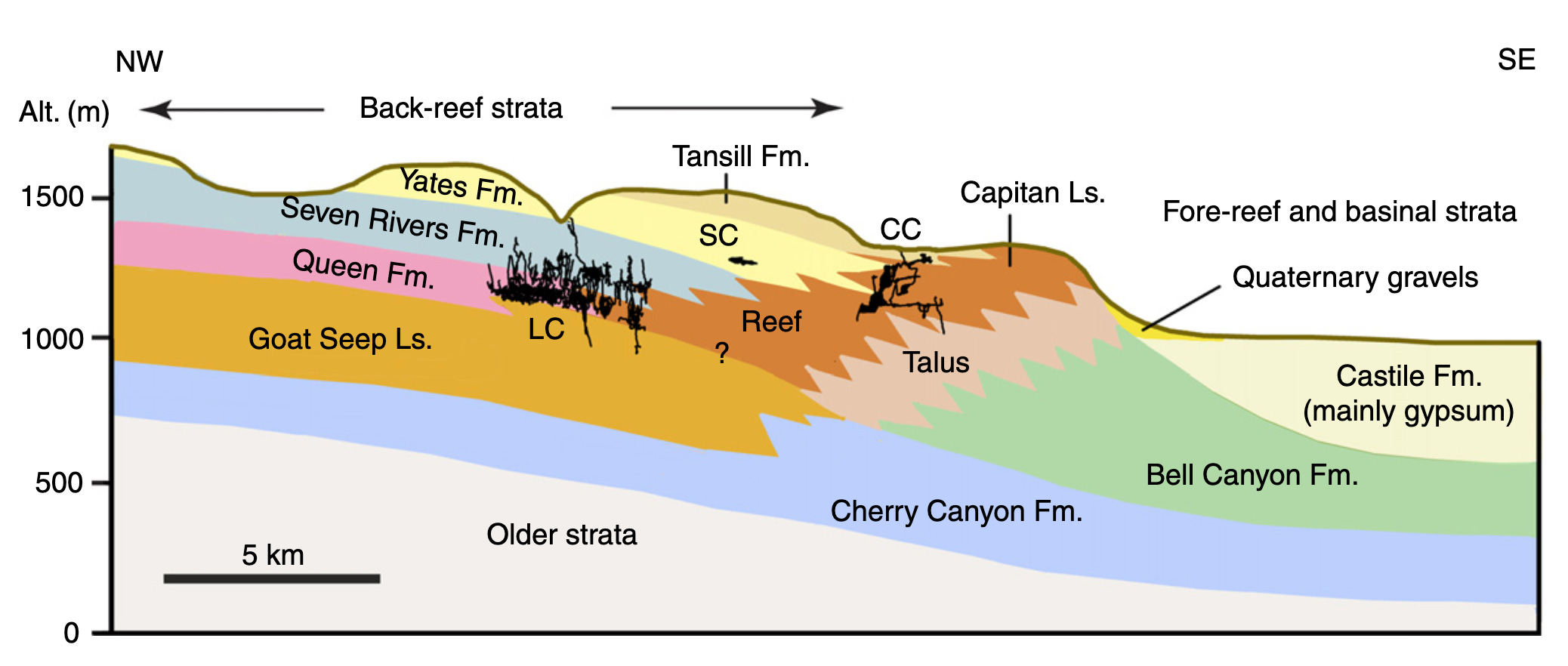
Generalized geologic cross section of the Guadalupe Mountains showing the relationship of Carlsbad Caverns and other caves to the various Permian Reef complex stratigraphic units. (CC - Carlsbad Caverns, SC- Spider Cave, LC- Lechuguilla Cave)
But while erosion and uplift revealed the Guadalupe Mountains from above, Carlsbad Caverns was carved from within: dissolved out of the reef by acid working its way upward from below. This difference is crucial. Carlsbad is not simply a cave system that happens to be in limestone. It’s a structural dissection of the reef itself, a three-dimensional glimpse into the interior of one of the best-preserved fossil reef complexes on Earth.
Most caves in the world form through a well-understood process: slightly acidic rainwater seeps downward through limestone and slowly dissolves it. This carbonic acid dissolution produces the classic cave systems we’re familiar with: Mammoth Cave in Kentucky being the best example in North America.
Carlsbad did not form this way. It formed from the bottom up.
The Petroleum Connection
Here’s where it gets wild.
The Guadalupe Mountains form the western margin of the Permian Basin, the same geological feature recognized as one of the most prolific oil-producing regions in North America. This basin is essentially the deep seafloor of that Permian inland sea, compacted and transformed over hundreds of millions of years into hydrocarbon-rich deposits that now drive a substantial portion of American energy production.
Around 20 million years ago, as the Guadalupe Mountains were being uplifted by tectonic forces, oil and gas from the deep marine sediments began migrating upward. When rising natural gas (CH₄) encountered the evaporites of the Basin fill, it reacted with anhydrite (CaSO₄) to release hydrogen sulfide (H₂S). This H₂S continued migrating upward into the reef complex where it encountered oxygen-bearing groundwater at the water table.
The reaction of H₂S and groundwater formed sulfuric acid, one of the most corrosive substances in nature. That acid then went to work on the Capitan limestone from below, and over millions of years, dissolved enormous chambers and passages.
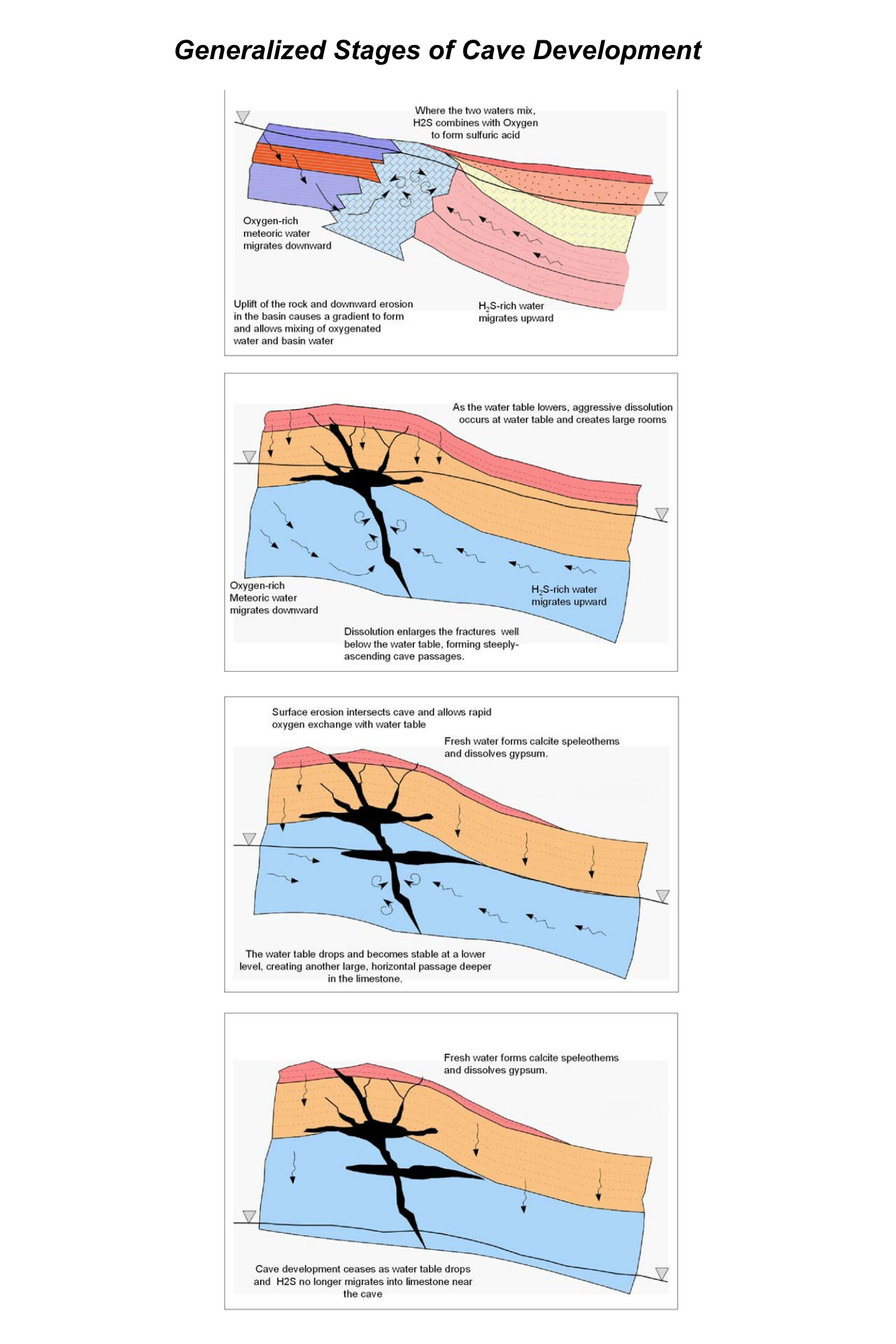
Simplified diagram of hypogenic cave formation of Carlsbad Caverns involving sulfuric acid (modified from National Park Service)
The evidence is written in the cave itself. Thick deposits of gypsum (CaSO₄·2H₂O), a mineral produced when sulfuric acid reacts with limestone, coat the floors and walls of Carlsbad’s passages in some areas there are layers up to 10 meters deep!
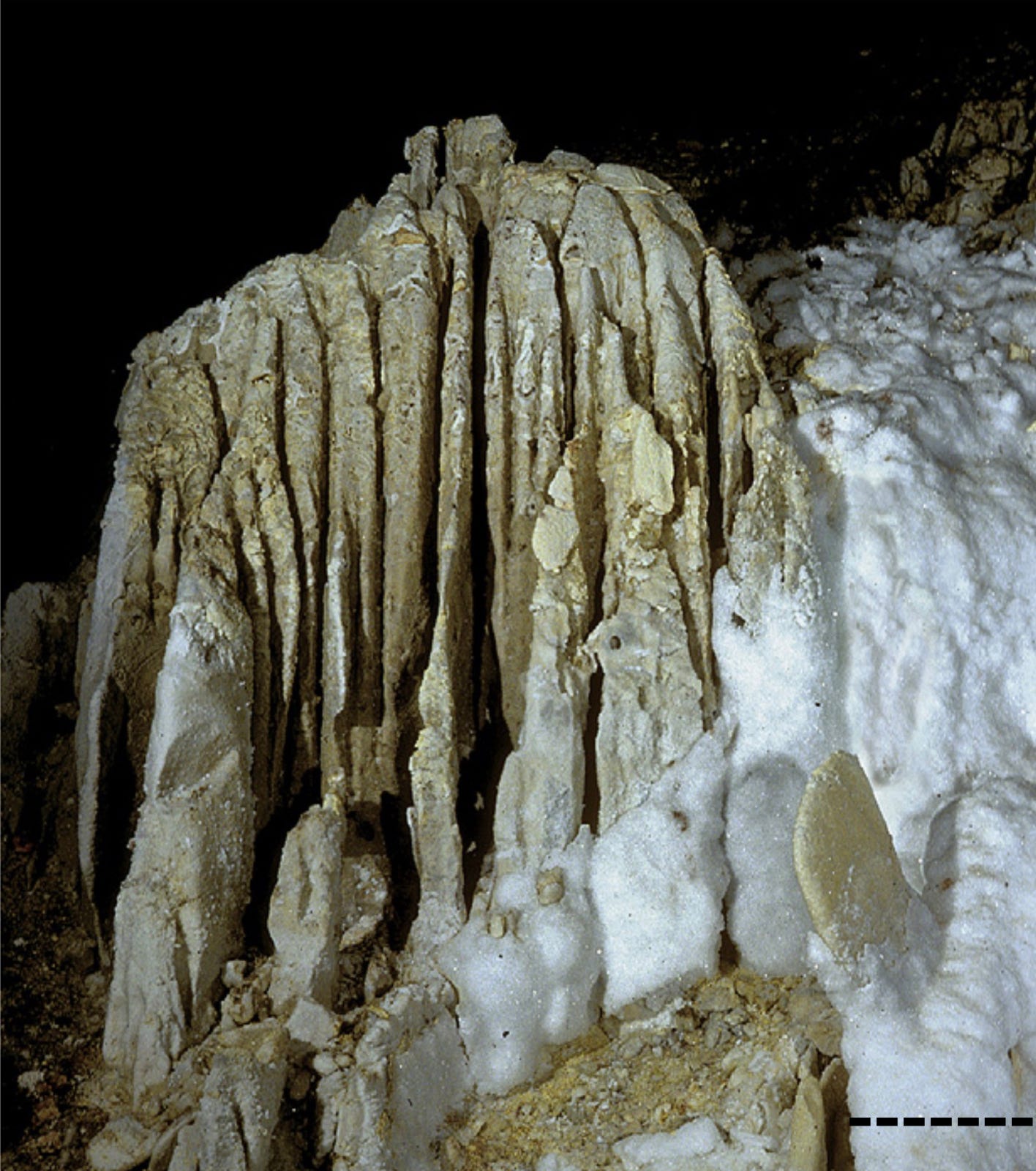
An example of gypsum coating the cave floor. Gypsum is a product of sulfuric acid reacting with CaCO3 of the limestone. Scale bar = 25 cm (image from Palmer, 2013)
The Big Room, the cave’s most famous chamber, was not carved top-down by percolating water but dissolved laterally at the water table. That’s why its floor is so remarkably flat: it was once the surface of an underground pool of sulfuric acid.
This process, known as sulfuric acid speleogenesis or hypogenic cave formation, is rare. Fewer than five percent of the world’s caves formed this way. The key scientific paper establishing this origin, published by geologist Carol A. Hill in 1990 in the AAPG Bulletin, became a landmark in cave science. The Guadalupe Mountain caves have since become the global reference standard for understanding how sulfuric acid caves form.
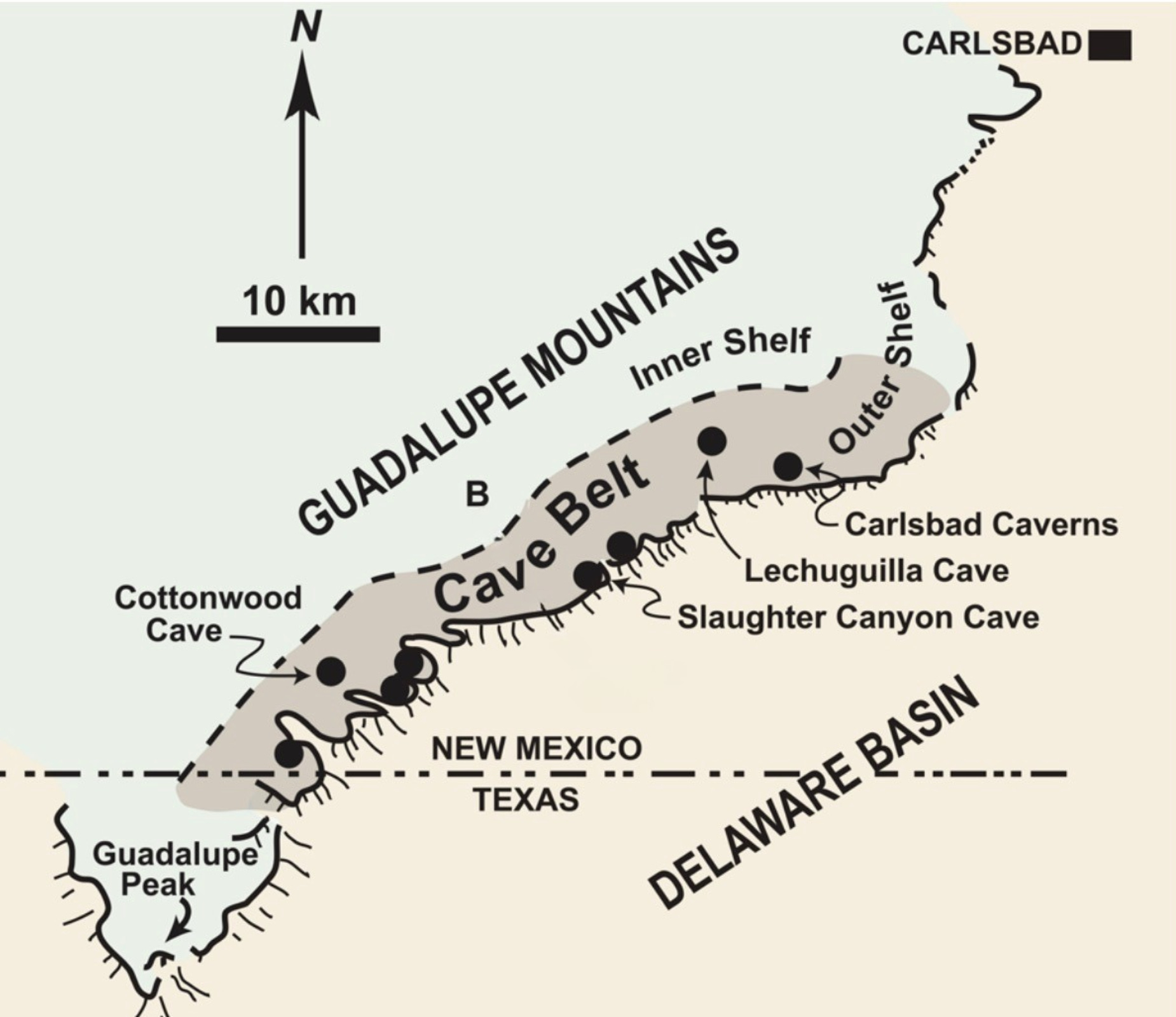
Notable hypogenic caves of the Guadalupe Mountains region (image from Kirkland, 2014).
The Cave Itself
What the acid left behind, after groundwater eventually drained away and air began circulating, is a cave system of staggering scale and beauty.
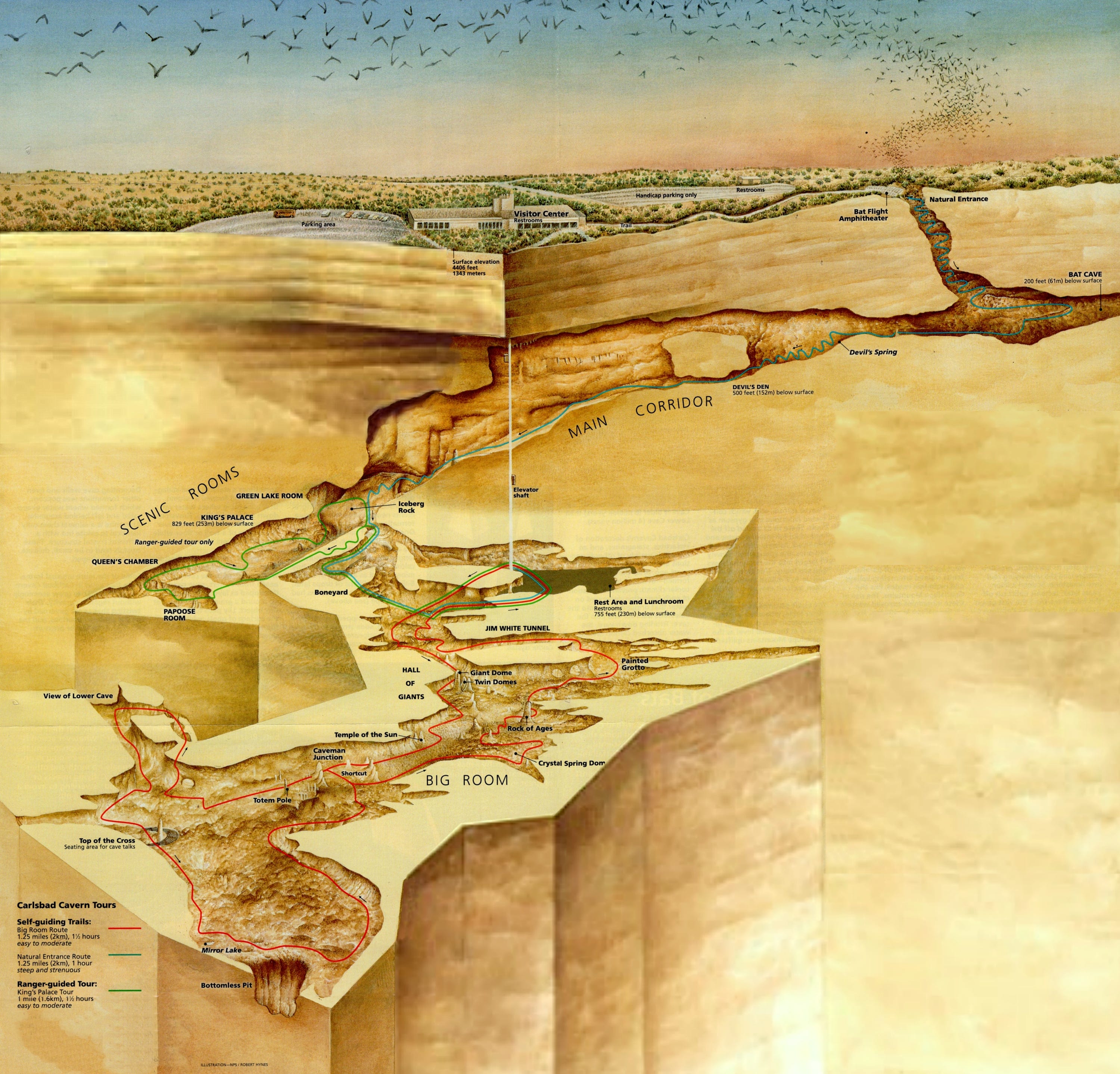
Three-dimensional representation of Carlsbad Cavern (Haynes, Wikimedia Commons)

The main attraction is accessible either via a 2 km walking trail that descends through the Natural Entrance, a vast, shadowed opening that plunges into the side of the reef, or by elevator, which drops 225 meters to the Big Room in roughly a minute. The elevator is practical. The Natural Entrance trail is theatrical: a slow transition from desert daylight into one of the largest underground spaces in North America.
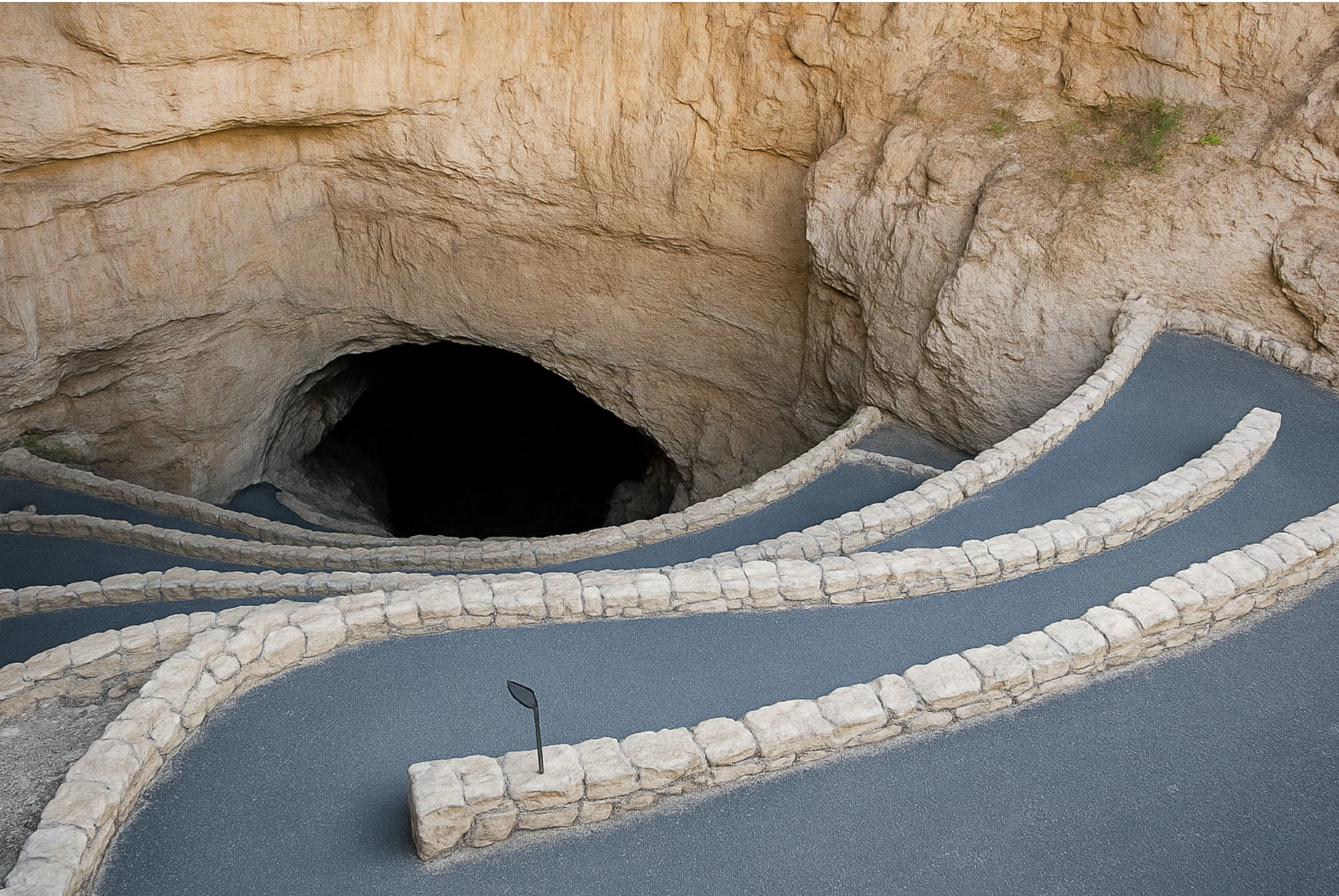
The Natural Entrance trail descending into Carlsbad Caverns
The Big Room is the centerpiece. It covers 8.2 acres (roughly six and a half football fields) and reaches a ceiling height of nearly 100 meters at its highest point. A 2 km paved trail loops around its perimeter, past formations that seem designed to test vocabulary:
Stalactites hang from above
Stalagmites rise from the floor
Columns stand where the two have merged over millennia, like frozen fountains
Draperies of translucent calcite hang in folds from the ceiling
Soda straws, hollow calcite tubes, some over a meter long and delicate as blown glass, project downward from cracks
Cave pearls, formed when calcite precipitates in concentric layers around a nucleus tumbled by dripping water, cluster on the floor in polished nests
It’s overwhelming in the best possible way.
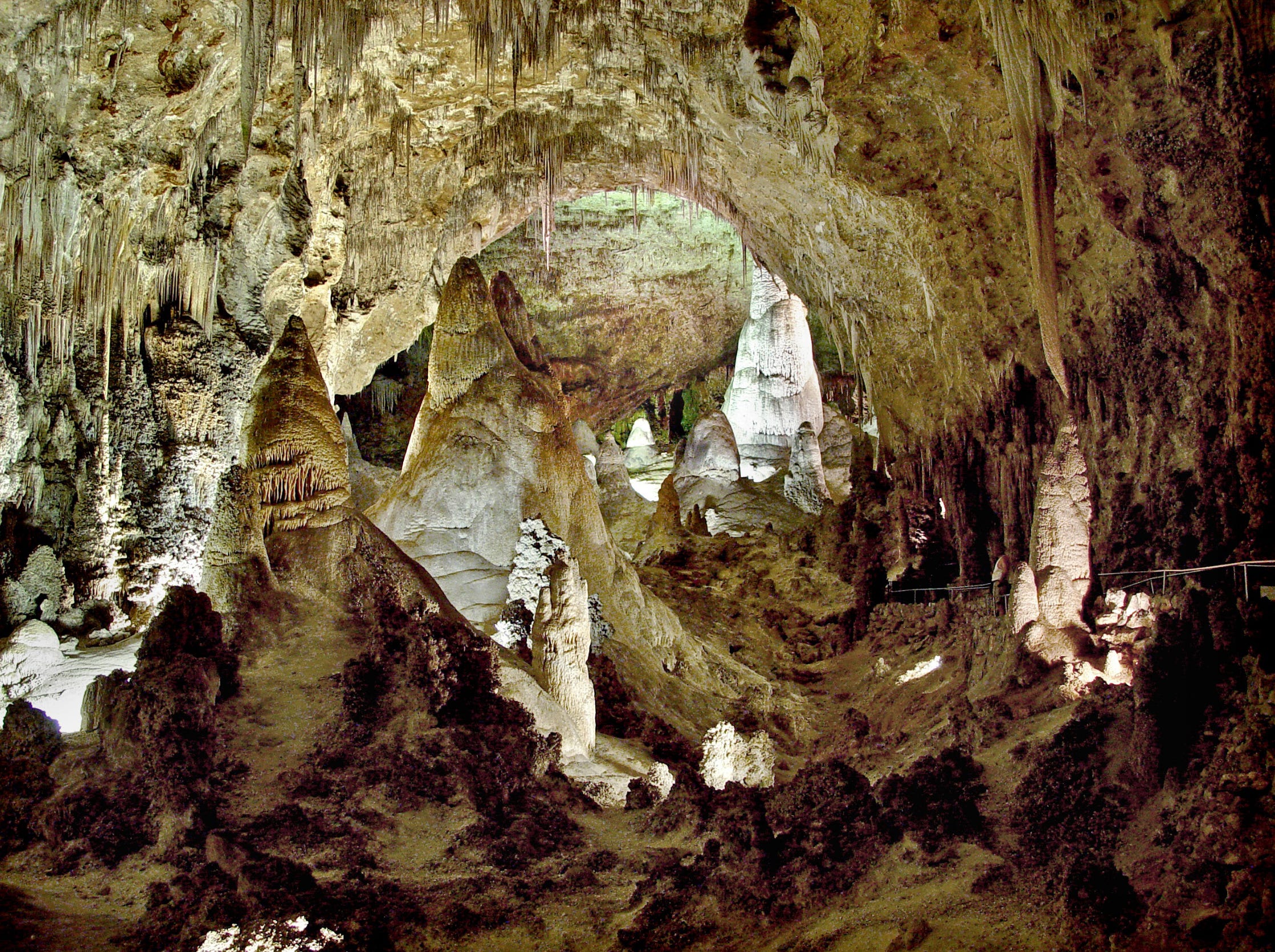
A portion of the Big Room, Carlsbad Caverns. Note the walking trail for scale (image from Kirkland, 2014).
Lechuguilla: The Cave Beneath the Cave
If Carlsbad Cavern is the park’s famous public face, Lechuguilla Cave is its scientific soul.
Discovered only 40 years ago when explorers broke through a rubble-filled pit in a remote corner of the park, Lechuguilla is off-limits to the public. Access is restricted to approved researchers and survey teams because the cave exists in a state of pristine preservation that is extraordinarily rare. At over 250 km of surveyed passages and a depth of nearly 500 meters, it ranks among the longest and deepest caves in the world.
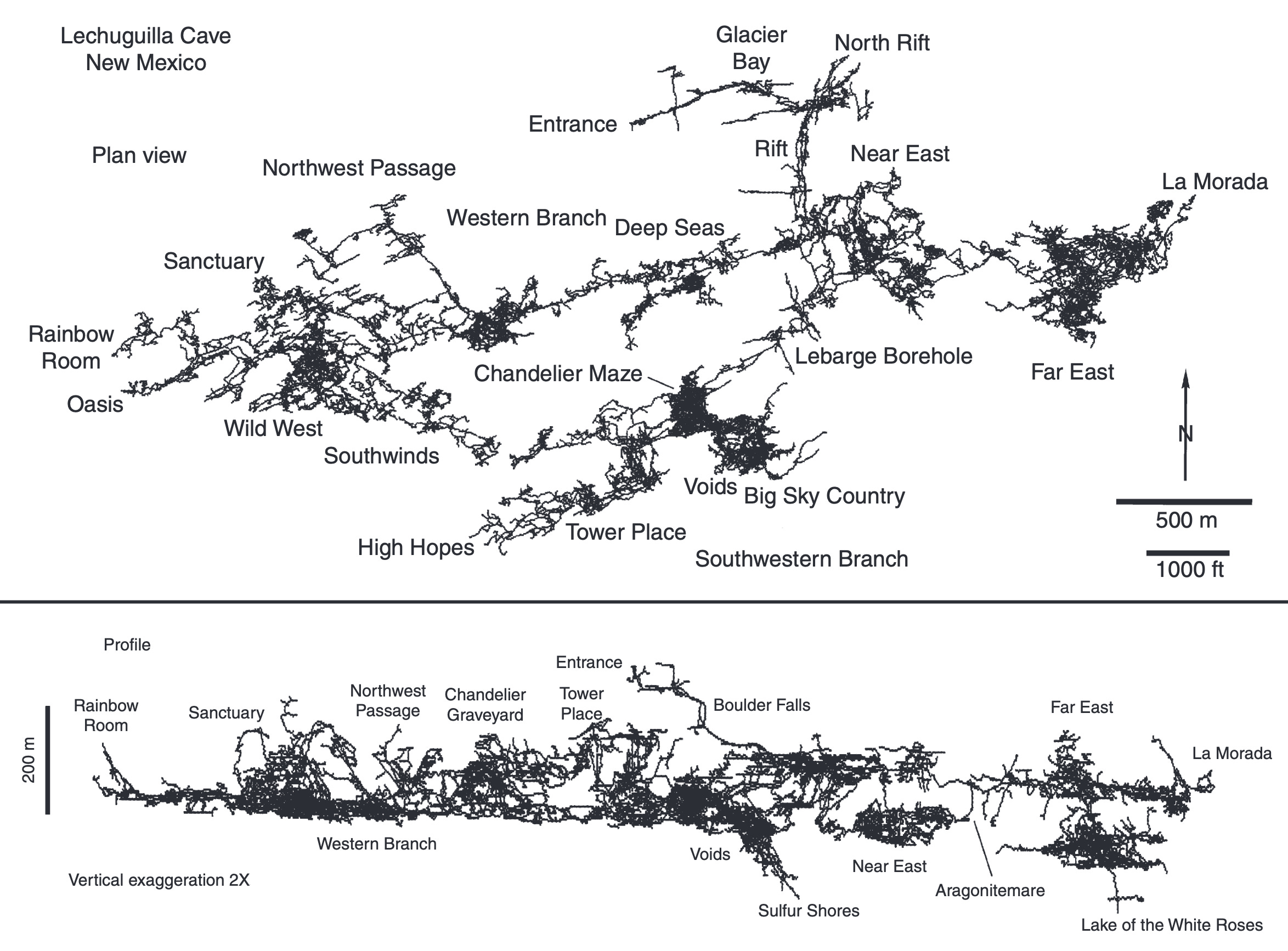
Map and profile of Lechuguilla Cave (from Palmer, 2013)
The formations here are unlike anything else on Earth. Gypsum chandeliers up to 6 meters long hang from ceilings. Gypsum “hairs”, filaments so fine they tremble in still air, form curtains along the walls. There are magnesium carbonate (hydromagnesite) balloons, pools of calcite-rimmed cave water so still they look like polished stone, and passages whose walls are encrusted with minerals rarely found anywhere else.
But perhaps Lechuguilla’s most significant contribution has nothing to do with visual grandeur. Microbiologists studying bacteria isolated from deep within Lechuguilla, organisms that have existed in complete isolation from the surface world with no access to sunlight surviving entirely on chemical energy, have found strains with resistance to modern antibiotics.
In a world of deepening antibiotic resistance, these extremophile bacteria represent a potentially significant frontier in pharmaceutical research. This reshapes our understanding of where antibiotic resistance comes from. Clearly the antibiotic resistance evolved BEFORE human-made antibiotics. This is HUGE; it will allow microbiologists to study mechanisms of antibiotic resistance, perhaps identifying resistant genes previously unknown in the world of antibiotic research. By studying these ancient microbes, scientists may gain powerful tools to anticipate and outmaneuver the drug resistant superbugs we see today.
The ironies of natural history rarely come that neatly packaged.
The Bat Flight
No account of Carlsbad Caverns is complete without the bats.
From late April through October, between 200,000 and 500,000 Brazilian free-tailed bats roost in the cave’s Bat Cave section, nursing their pups through the summer and emerging each evening at dusk in a spectacle that draws visitors from around the world. At peak migration periods in late summer and early fall, the numbers can swell past one million.
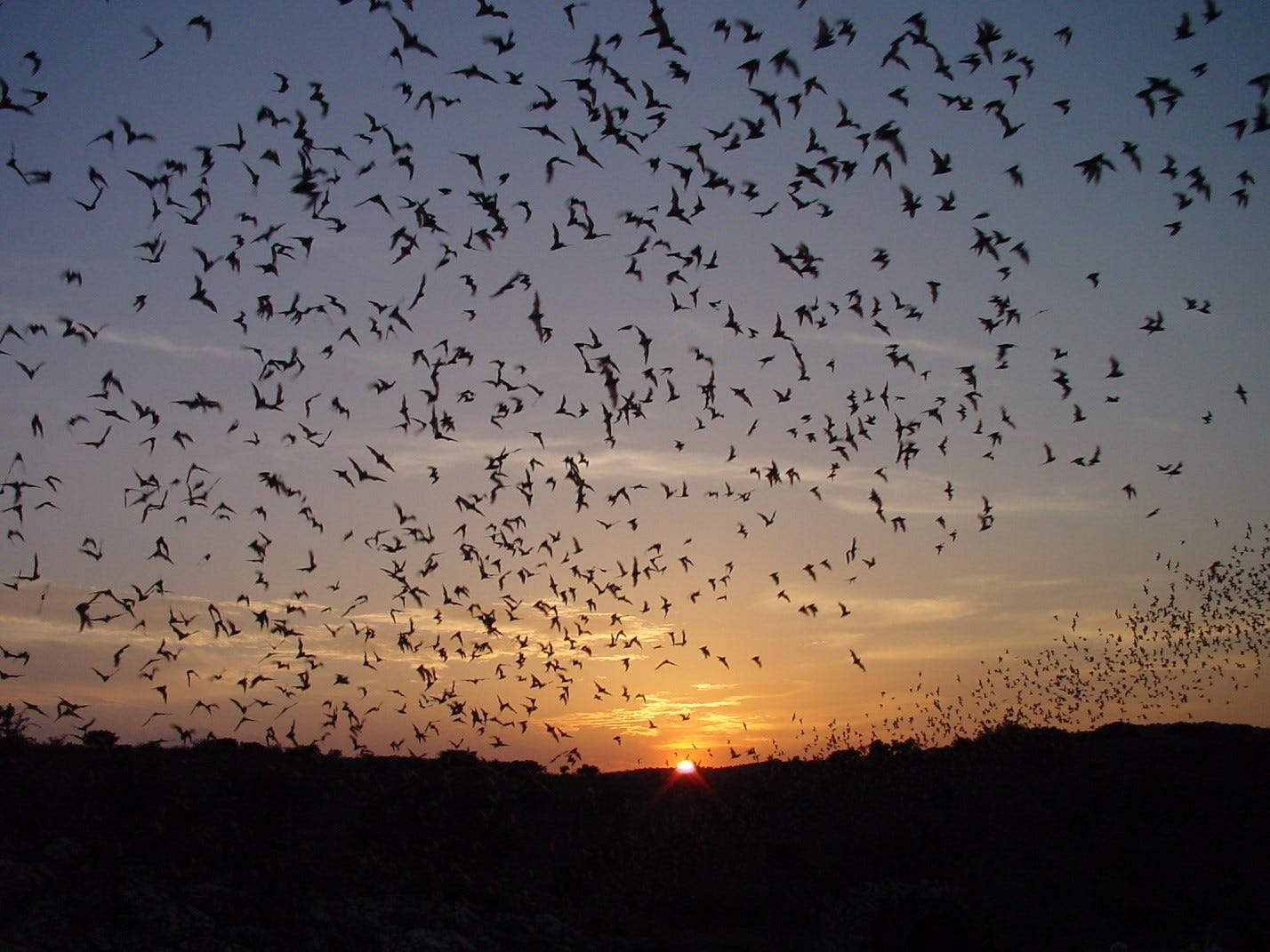
Evening emergence of Brazilian free‑tailed bats from Carlsbad Caverns (image from National Park Service)
The park maintains an outdoor amphitheater at the natural entrance where visitors gather each evening to watch the emergence. A ranger offers a brief talk, and then the bats simply start to pour out of the cave mouth. The column of bats spiralling upward can last for several hours and is one of the great wildlife spectacles in North America.
The ecological significance is considerable. The Carlsbad colony alone consumes 2,000 to 3,000 kg of insects each night, including agricultural pests that would otherwise damage alfalfa and cotton crops across the region.
But the colony nearly vanished. Estimated at nearly nine million bats in 1936, it had collapsed to around 218,000 by 1973 due to pesticide accumulation and direct human disturbance. Numbers have partially recovered since then, though they haven’t returned to historical levels, a sobering reminder of how much was nearly lost.
Two Sides of the Same Rock
Combined with a visit to Guadalupe Mountains National Park across the Texas state line, Carlsbad offers what may be the most complete geological double feature available anywhere in the American Southwest: the reef as it stands on the surface, and the reef as it was dissolved from within. Two parks, the same limestone, two utterly different stories about what time and chemistry can do.
Next in the series: The Permian Basin : How the same ancient sea that built a reef and carved a cave also created one of the world’s great petroleum provinces.
Further Reading
Essential Geological Works
Hill, C.A., 1987. Geology of Carlsbad Cavern and Other Caves in the Guadalupe Mountains. New Mexico Bureau of Mines and Mineral Resources Bulletin 117 (freely downloadable)
Hill, C.A., 1990. Sulfuric Acid Speleogenesis of Carlsbad Cavern. AAPG Bulletin, 74(11): 1685–1694. The landmark paper that established the H₂S/sulfuric acid origin
Kirkland, D.W. 2014. National Cave and Karst Research Institute Special Paper 2: Role of Hydrogen Sulfide in the Formation of Cave and Karst Phenomena in the Guadalupe Mountains and Western Delaware Basin, New Mexico and Texas. Carlsbad (NM): National Cave and Karst Research Institute. 77 p. The most up-to-date and complete summary of cave generation in the Guadalupe area with excellent illustrations and extensive bibliography.
Official Resources
Lechuguilla & Antibiotic Resistance
Bhullar, K., et al., 2012. Antibiotic Resistance Is Prevalent in an Isolated Cave Microbiome. PLOS ONE, 7(4): e34953
Pawlowski, A.C., et al., 2016. A Diverse Intrinsic Antibiotic Resistome from a Cave Bacterium. Nature Communications, 7: 13803
Virtual Field Trip
We live along the Petitcodiac River, known as Petkootkweag, on the traditional and unceded territory of the Wolastoqey (Maliseet), Mi’kmaq, and Passamaquoddy Peoples of the Wabanaki Confederacy. This river has long been a place of movement, sustenance, and relationship, shaped by tides, time, and care. We acknowledge the enduring presence and knowledge of Indigenous Peoples whose stewardship continues to guide this land and water, and we offer this acknowledgement as a commitment to listen, learn, and act with respect.
This is very interesting to read
Very nice read. Carlsbad was/is one of my favorite public caves because they let you wander through it at your own pace. The phreatic sponge work development is particularly spectacular. It also intrigues me that sulfuric acid speleogenesis may be microbially mediated. Do you think that is the case generally, including for Carlsbad?
Annette Summers Engel, Libby A. Stern, Philip C. Bennett; Microbial contributions to cave formation: New insights into sulfuric acid speleogenesis. Geology 2004;; 32 (5): 369–372. doi: https://doi.org/10.1130/G20288.1